Midterms, Finals, and Feeling the Pressure? Here Are Practical Ways to Reset
From 60-second breathing resets to better sleep routines, a Columbia Health specialist shares workshop-backed strategies to help students (and all of us!) manage stress.
Maybe you've noticed it: Library seats are filling earlier, calendars are suddenly booked with study sessions, and your sleep schedule has started to slip. Yep. That's a sure sign it is midterms or finals season. For many students, this is the time when stress, time pressure, and self-doubt start to rise to the surface.
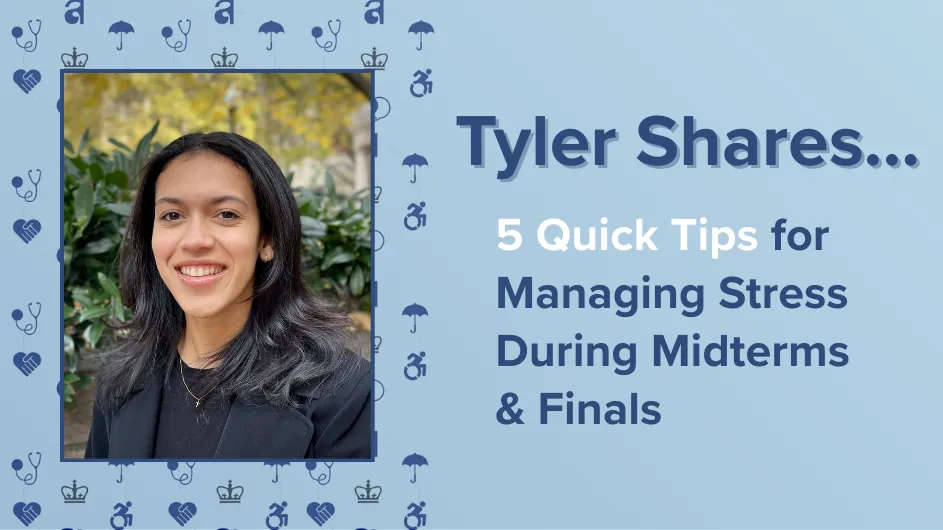
At Columbia Health's Alice! Health Promotion, Tyler Conzone, a health promotion specialist, works with students every day through workshops, health education visits, and campus outreach to build practical skills for navigating exactly these moments.
“Specific to midterm season, we always have students who come in to talk about stress management and time management,” Conzone said. “Just, what does it look like to have the ability to do it all, and is that even possible?”
As part of her role at Alice!, Conzone organizes well-being and skill-building workshops that are open to all Morningside/Manhattanville campus-based students (as well as Teachers College, Union Theological Seminary, and Jewish Theological Seminary).
Many of these sessions are facilitated by student peer educators (undergraduate and graduate students certified through NASPA). “They’re providing examples that are relatable and realistic, and also creating space for students to connect with students,” Conzone said. “They do such wonderful work.”
Four workshops are offered each month, including recurring sessions on stress management, sleep, and time management, along with rotating programs focused on substance use and recovery topics. Student groups can also request tailored workshops for their organizations or departments.
Below are five workshop-backed tips to help manage stress during midterms and finals—and how Columbia students can put them into practice right now.
1. Step Outside (Even for 20 Minutes)

Try this: Spend 20 minutes in nature to boost your mood.
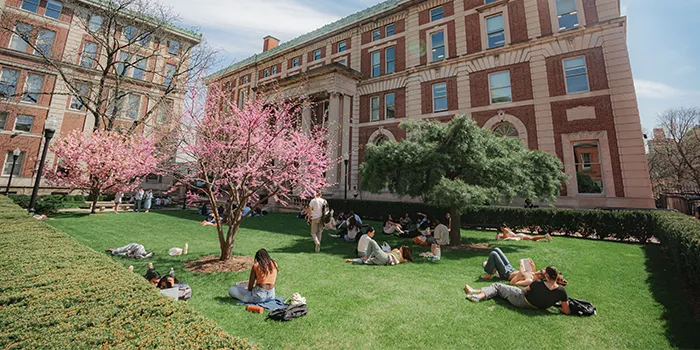
In the “Connecting With Nature” workshop, students explore the relationship between environment and well-being. Research shows that even brief exposure to green or blue spaces can reduce stress.
At Columbia, that might mean walking through Riverside Park, catching a view of the Hudson River, or simply circling the neighborhood between study blocks. It doesn't have to be a long outdoor excursion!
“Not everybody is the ‘get-outside’ type of person, so we talk about curated nature, too,” Conzone said. “There are benefits to going to a museum and looking at pictures of nature or utilizing playlists where you're listening to nature sounds, or if your screensaver on your phone or laptop is a nature space. Even looking at that and taking a pause does have positive benefits to reconnect and recenter.”
2. Use a 60-90 Second Breathing Reset
Try this: Inhale for four counts, hold for four, exhale for four, hold for four. Repeat for one minute.
The “Reducing and Managing Stress” workshop teaches box breathing as a fast, accessible tool students can use anywhere when anxiety strikes (only if it works for you!).
“It provides a moment of calm,” Conzone said. “It taps into the present moment and promotes a sense of mindfulness. It's such an accessible way to employ a stress management technique. You can do it anywhere, at any time, and it really provides a moment of centering for folks to take a second and reassess.”
Students also discuss a concept known as the “fear-based model of excellence”: the idea that operating from fear of failure can drive overwork, procrastination, and self-doubt.
“When we are operating from this fear that we are going to fail, it impacts the way in which we engage in our homework assignments or test taking,” Conzone said. “We move from a place of accomplishing certain tasks and feeling proud of ourselves to ‘Because I'm scared to fail, I need to prove that I'm doing well.’ And that can turn into needing other people to say that we're doing well versus having the self-confidence to validate that ourselves.
“We talk about moving from a fear-based perspective to a values-based one. This looks like prioritizing self-care and rest, or living life in alignment with your values or what's important to you!”
The workshop also introduces what Alice! calls the “four A’s” of stress management:
- Avoid unnecessary stress
- Alter the situation to fit your needs
- Adapt to the stressor in a way that feels manageable
- Accept what’s outside your control
3. Stop scheduling everything. Start with essentials.

Try this: Identify 2-3 non-negotiables each day and build from there.
In the “Time Management” workshop, students examine how overbooking and overscheduling can stem from pressure to “do it all.”
Instead, they're encouraged to:
- Tackle high-energy tasks early in the day
- Break larger projects into small steps
- Set realistic daily goals
- Choose a planning method that works for their reality (digital vs. paper methods)
Comparison also comes up frequently.
“Comparison is the thief of joy,” Conzone said. “It’s about figuring out what works for you rather than comparing yourself to others.”
4. Consistency Beats Perfection: Protect Your Sleep
Try this: Go to bed and wake up at roughly the same time, even on weekends.
In “Sleep 101,” students learn that consistency strengthens the body’s circadian rhythm.
“Your body will naturally start feeling sleepy around the same time and wake up more naturally versus feeling jolted out of bed,” Conzone said.
The workshop also covers light and noise management in New York City and creating a sleep-friendly environment
Bonus: Alice! offers free sleep kits—including earplugs and eye masks—to help students minimize environmental disruptions.
5. Noticing & Checking In > Fixing Your Friend
Try this: Notice. Check in. Connect your friends to support if needed.
During high-stress academic periods, it's easy to focus inward. But the “Friend2Friend” workshop reminds students that community care matters.
“We really want to highlight having the self-efficacy, that confidence, to say, ‘Hey, if you are feeling this way, this is somewhere you can go and someone you can talk to,’” Conzone said. “It’s not your job to fix it. You can be a friend. And being a friend also means making sure they’re getting to the right place.”
Columbia Health offers mental health services, wellness coaching, and peer education support for all eligible students. Knowing those resources exist and feeling confident using them can make a meaningful difference.
A Final Word: Check In With Yourself
If Conzone had to offer one personal strategy for navigating intense academic seasons, it’s simple: Make time to check in with yourself.
“Even if it is a small amount of time, five minutes, really asking, ‘What would be helpful for me right now?’ is so important,” Conzone said. “Being able to check in and think about how to support your well-being in the moment, no matter the strategy, is probably what I lean on most.”
For Conzone, that often looks like journaling. For others, it may mean calling a friend, taking a walk, or stepping away briefly before returning to work.
Midterms and finals will always bring pressure. But students don’t have to navigate it alone.
Students can find upcoming sessions and register through Columbia Health’s Well-Being and Skill Building Workshops page. Student organizations can also request a tailored workshop through Alice! Health Promotion.