Recent health and wellness news from across Columbia.
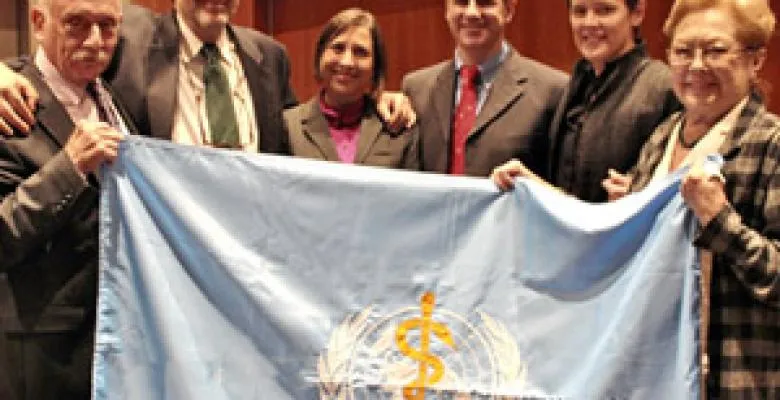
The World Health Organization (WHO) inaugurated the Mailman School’s Center for the History and Ethics of Public Health as a WHO Collaborating Center for Bioethics, the only such center that explicitly focuses on the ethics of public health.
An African-American or Mexican-American senior living in a community where many neighbors share their background is less likely to have cancer or heart disease than their counterpart in a more mixed neighborhood.

Child development specialist Cassie Landers, EdD, MPH, helped promote the idea of portable playgrounds to UNICEF two years ago when she saw its potential for children growing up in crisis and post-conflict areas and in places where opportunities for education and play are limited.

The incoming class of about 400 students are the first to be offered a redesigned curriculum that takes a new approach to training students to address 21st century public health concerns, from the global obesity epidemic to emerging infectious diseases to the impact of climate change.
Scientists generally think that reduced insulin production by the pancreas, a hallmark of type 2 diabetes, is due to the death of the organ’s beta cells.
The students, both of whom are interested in public health, were two of seven students chosen from a highly competitive field for a high school internship program run by Columbia’s Institute for Social and Economic Research Policy (ISERP).
Mailman Researchers Create a New Tool for Sizing Up the Impact of Anti-Obesity Policies
Researchers at ICAP’s Harlem Prevention Center joined the HIV Prevention Trials Network (HPTN) today to announce study results that showed disturbing rates of new HIV infections occurring among black gay and bisexual men in the U.S. (also known as men who have sex with men, or MSM), particularly among those age 30 and younger.
Duy Linh Tu, an assistant professor at Columbia Journalism School, has been teaching students digital storytelling techniques since 2002. So he was encouraging when a former student told him she wanted to make a documentary about the impact of HIV in the Deep South—and intrigued when she suggested he work on it with her.
Robert Shapiro is a professor of political science, who specializes in American politics, especially public opinion and political behavior, political psychology and political leadership.
Here’s his view on the issues raised in the U.S. Supreme Court’s 5-4 opinion on the Affordable Care Act.
One in eight people who suffer a heart attack or other acute coronary event experience clinically significant symptoms of post-traumatic stress disorder (PTSD), according to a meta-analysis of 24 studies led by Columbia University Medical Center researchers.

On June 8, a Head Start ribbon-cutting ceremony celebrated the opening of a brand-new space for the program.